
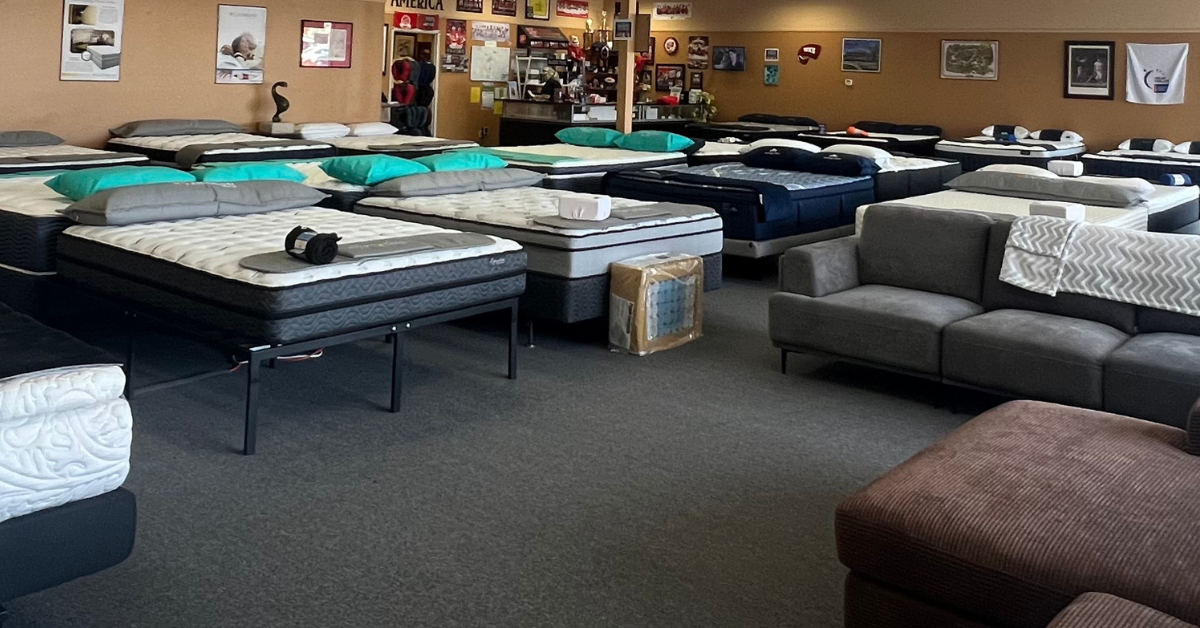
It’s no secret that the bedding industry has been in flux over the past few years. There have been strong elements, of course, like the luxury category that continues to perform well. Dave Perry, editor-at-large of Bedding News Now, recently covered a surprising bit of research that revealed in-store mattress sales are holding steady.
Trent Ranburger, owner of Bowling Green, Kentucky-based Trent’s Beds, perhaps best summed up the current bedding landscape: “I have no idea what’s going on. In 28 years of selling mattresses, this has been the most [all over the place]. We’ll have a great week and then a dead week, and there’s no rhyme or reason. It could be the first of the month or it could be the second week of the month. It’s just random sales right now.”
Despite Ranburger’s unpredictable sales, he says his Black Friday promotions were up 40% over last year. A welcome outcome, of course.
With 2026 upon us, the industry is keen to see how things will develop. And as the nascent new year begins to unfold, there are some key trends to note that will shape the industry in the months to come.
Consumer financing is shifting from a perk to an essential part of business. According to Mechanicsburg, Pennsylvania,-based Versatile Credit, there was increased credit utilization for Black Friday and Cyber Monday.
According to the company, “This trend signals the ongoing post-Covid phenomenon where unprecedented numbers of financially qualified applicants are seeking and utilizing secondary and tertiary financing options to manage budgets or maximize promotional terms.”
Versatile Credit found that the average requested purchase amount increased by 18%, demonstrating that there may be fewer consumers applying for financing but those who are, are pursuing substantially higher purchases. Versatile Credit also found that a newly defined demographic of consumer has emerged: the high-income, subprime applicant. For retailers, financing is a must-have going forward to capture more sales.
Something else that will be integral to increasing sales? Agentic artificial intelligence. Whether businesses embrace artificial intelligence or are a bit wary of its implications, its impact is already undeniable. Keeping up with its evolution will be essential to strong businesses.
AI platforms like ChatGPT and Google’s Gemini will evolve from search engines to agents. According to Matthew Dishman, CEO of Charlottesville, Virginia-based company LendPro, agentic AI will revolutionize shopping. Consumers in search of a mattress, for example, can input all parameters from size to color to price range to financing options, and allow the agent to complete the purchase on their behalf.
In December 2025, Ashley Furniture unveiled a partnership with AI-powered search engine Perplexity that allows shoppers to check out with PayPal. Ashley Furniture’s CEO, Todd Wanek, has been vocal about the company’s investments in AI, reported to be approximately $2 billion. While most bedding retailers cannot match that scale, it will be important to find ways to integrate AI where possible.
I predict that, similar to how Amazon’s fast, free shipping revolutionized consumer expectations and inspired a generation of retailers to keep up, the same will happen with agentic AI, forging new expectations for shoppers increasingly in pursuit of seamless experiences.
Another thing to keep an eye on is sustainability. While not new, the way companies are talking about it — or in recent months, not — is notable. Sustainability-focused messaging underwent an interesting shift in 2025, with many companies scaling back on communicating about their green products or initiatives.
In its fall 2025 B2B Pulse report, marketing and communications agency ERM Shelton identified this as a “green comms recession.” It found that in the U.S., “business buyers perceive many of the topics their companies are communicating about to be risky,” including climate change, net zero and ESG.

It also noted that some were planning to scale back communications altogether. However, companies that tell a strong sustainability story are seen in a positive light by consumers who view it as an indicator of trustworthiness. The report found that companies that continue marketing through a recession outperform peers in the years afterward.
One example is Love Home Fabric’s Moreganic brand, an award-winning, all-natural line of latex, whose sustainability story is central to its marketing. Although companies might be inspired to pull back, there’s a clear opportunity to stand out in a crowded marketplace with unique, sustainable-forward storytelling.
In other news, this year also marks the first phase of the European Union’s Digital Product Passport, which traces products throughout their lifecycle and provides material and sustainability information to consumers. In the coming years, it will roll out to additional categories, including mattresses and furniture. Although no similar plan is currently in the works in the U.S., it’s a sign of the times.
Although the industry has been flat in recent years, perhaps it’s better to think of this time as the eve of a new dawn. With shifting global policies, new technology and evolving consumer preferences, 2026 will likely be a transformative year in the bedding industry.
One bellwether will be the upcoming Las Vegas Market, taking place Jan. 25-29. I’m looking forward to seeing the product debuts, gauging the foot traffic and getting a sense of what other trends to keep an eye on. If we’ve learned anything in this category over the past few years, it’s to expect the unexpected.