
When Helix co-founders Jerry Lin, Adam Tishman, and Kristian von Rickenbach first shared their idea of a direct-to-consumer bedding brand with the University of Pennsylvania’s Wharton School of Business, they got feedback they’ll never forget.
Tishman recalled: “I distinctly remember when we applied to the Wharton Business School business plan competition, the number one feedback that we got was, ‘This is the dumbest idea ever. You’re never going to convince someone to buy a mattress online.’”
Fast-forward to now, and Helix is one of the hottest brands in the bedding industry. By mid-2025, Helix had expanded into over 300 retail stores nationwide, including major regional powerhouses like Sit ‘n Sleep, Mancini’s Sleepworld, Raymour & Flanigan and Living Spaces.
But what makes Helix so successful? It certainly isn’t alone in the DTC category, and in recent years, it has noticeably expanded its physical retail presence. Since its launch in 2015, Helix has used four distinct strategies to become a bedding behemoth: customization, vertical integration, an expansion into physical retail and marketing strategy that converts online traffic to in-store foot traffic.
“All the e-com DTC brands when they launched were doing one thing, which was, ‘This is the one mattress model, it’s the best thing for everyone,’” said Lin. And that just didn’t sit right with us. You can’t tell me a 300-pound football player sleeps on the same mattress as a 100-pound gymnast, right? Helix was born out of this ethos: ‘Hey, we believe that all individuals are unique.’ We all have different sleep preferences; we shouldn’t be sleeping on the same thing.”
At Helix, customization is key.
“We settled on the name Helix to evoke the idea of the double helix in everyone’s DNA,” said Lin. “We wanted to be the exact opposite of all these copycat brands that launched around 2015, and be a company that stood for personalization within the mattress category.”
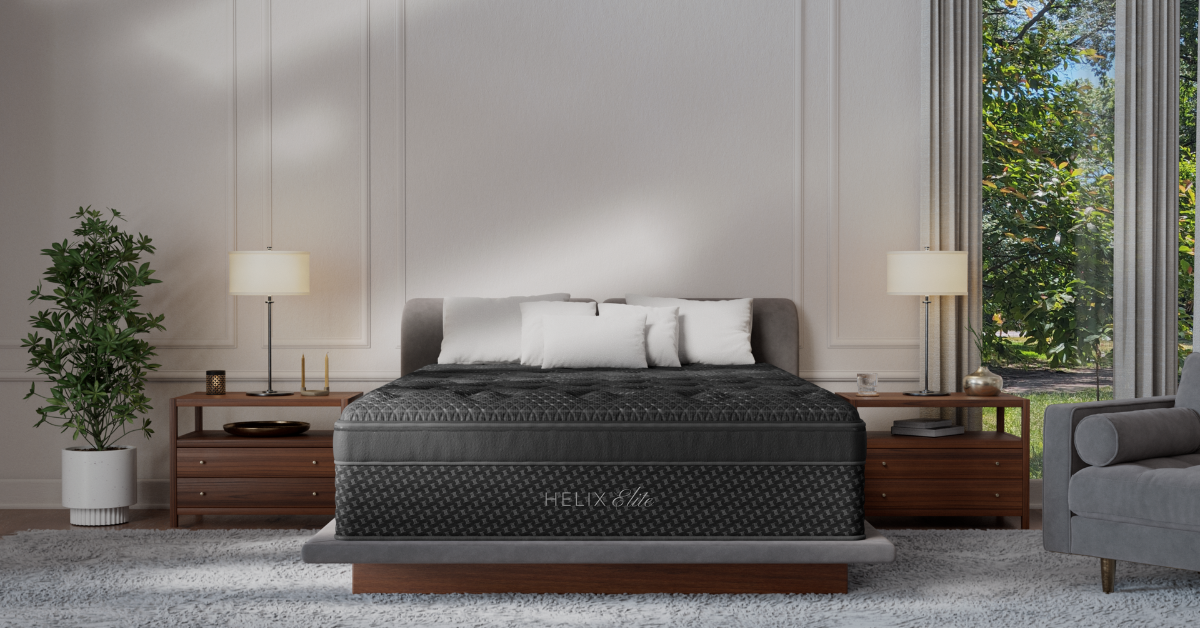
Helix originally launched with its Core line before debuting its higher-priced Luxe line in 2018. Luxe, however, was off to a slow start, which the founders say taught them a lesson about online consumers that would pave the way for future launches, namely its higher-tier, six-model Elite line.
“The e-com customer is not synonymous with the value customer anymore,” Lin said, explaining that while online buyers still want good value, that does not mean they are only looking for discounts. The Luxe line’s eventual success showed that consumers would buy premium products online if they solved specific sleep needs.
Tishman credits Helix’s 2021 merger with Brooklyn Bedding (now doing business as 3Z Brands) as one of the key moments for the company.
“Because we are vertically integrated, we have multiple plants, we make our own foam and springs that unlock all this margin that allows us to give retailers what they want,” said Von Rickenback.
He said retailers want four things: a brand that drives foot traffic; qualified leads; margin on the products they sell; and the ability to sell products and brands they can trust. By being vertically integrated, Helix has complete quality control from beginning to end, which has the added benefits of building brand trust and reducing the amount of comfort returns.
“Generating trust is so important because it takes a long time to sell a $3,000 mattress to a customer, and it can be very demoralizing when that product then returns because of quality issues or the fact that it doesn’t feel good,” said Von Rickenback. “So I think pound for pound, all of our products are doing well because when you compare it against other brands at retail, our products stand up.”
Helix’s vertical integration also set the company up to successfully expand into physical retail, which was prompted by an insight about its website traffic.
“One of the things that we came to realize is that we bring millions of people to our website every single year, and the reality is that we only convert 2% of the people that come to our website,” said Von Rickenbach. “The number one reason why people don’t buy from us online is they want to try and feel it, right? We spend millions of dollars every single month on attracting people to our website to educate them about who we are and our products, and if the reality is that we can only convert 2% of them, we’re leaving so many customers on the table by not being where they want to shop.”
An expansion into brick-and-mortar was a way to further monetize the online traffic they already spent money acquiring. Von Rickenbach said when 3Z Brand’s acquisition of Southerland was completed in 2024, that was “monumental” because it provided Helix the manufacturing capability and footprint to be able to service all the brick-and-mortar retailers they wanted to partner with nationwide.
“We had the benefit of being a late mover as a DTC brand into brick and mortar, and we were able to outline a strategy that I think would create a foundation for us to succeed,” said Von Rickenback.
Helix doesn’t just ship products, instead offering a retail program that delivers qualified leads to retailers. When a retailer signs up to partner with Helix, they’ll work with their marketing teams and place each of the store locations into their system. Then when Helix receives online traffic to its website near a retail partner store, they deploy co-branded retargeting ads (featuring both Helix branding as well as the partner’s store) on Meta and other marketing channels to further incentivize the traffic they don’t convert online to go visit the stores.
“It’s really powerful,” said Von Rickenback. “We get a lot of feedback from our retailers that we almost act like an agency, which is exciting. We’re able to take the capability that we have on the DTC side and package it in such a way that delivers value, traffic and qualified leads to our retail partners.”
Fueled by its robust retail program, Helix is accelerating its growth. In the past month, the company has announced partnerships with City Home, a 26-location retailer based in Fort Lauderdale, Florida, and Denver Mattress Company headquartered in Denver, increasing its retail presence to 106 Denver Mattress and Furniture Row locations.
“When we originally started Helix, it was: ‘Can we build a brand? Can we drive value? Can we be one of the bigger DTC brands?’ And I think now our goal is to be one of the larger brands in the country and ultimately the world,” said Tishman.